Friday, February 07, 2025

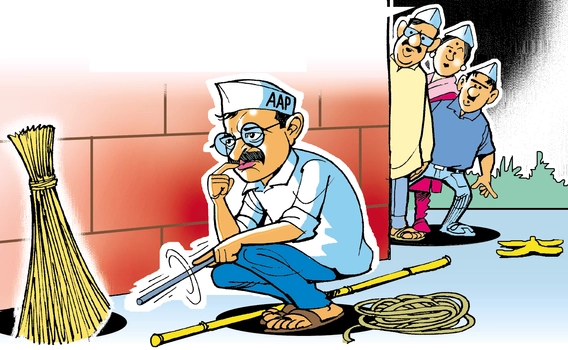
End Of The Road For Kejariwal?


The Delhi assembly elections concluded a couple of days ago, and the exit polls released yesterday indicated a stunning defeat for the Aam Aadmi Party. In recent years, exit polls have frequently provided inaccurate predictions. A notable example is the last Lok Sabha general elections, where it was widely assumed that the BJP would secure at least 320 seats, but the party ended up with only 240 seats, which was a significant disappointment. It is possible that the exit polls are also mispredicting the results of the Delhi assembly elections. Perhaps the exit polls are also mispredicting Delhi assembly results. 

As we keep a close eye on the election canvassing, we see some intriguing developments that could pose challenges for AAP. It’s important to note that both the party and Arvind Kejriwal have had a compelling rise, largely thanks to media coverage that painted them as champions of the common man. Kejriwal emerged as a figure of hope for many, a refreshing change in a political landscape often marred by corruption. He skillfully navigated the complexities of politics, gaining significant popularity along the way.

However, it seems Kejriwal may have misjudged the voters' perceptions. People are sharp and can see beyond the surface—many have sensed a shift from the idealism that once defined him to a more conventional, power-driven approach. Nonetheless, voters still showed their support during the assembly elections for several reasons. The Congress party’s tarnished reputation created a yearning for change, and the BJP wasn’t able to present a strong contender to challenge Kejriwal's position.

This situation opened a door for new possibilities. Voters were eager to embrace an innovative force, hoping for improvement. Unfortunately, rather than truly reading the room, Kejriwal may have let the adulation cloud his vision. While he certainly gained skills in political maneuvering, it’s crucial to remain grounded and connected to the people to sustain that trust and support. 

The Aam Aadmi Party (AAP) has consistently struggled to gain support beyond voters in Delhi and Punjab. While the party had a remarkable victory in Punjab, successfully taking the state from the Congress party, this was the peak of its achievements. Since then, the AAP has suffered defeats in three consecutive Lok Sabha elections and has not won a single Lok Sabha seat in Delhi, since its inception. This lack of success indicates a growing maturity and perceptiveness among voters. 

The cantankerous nature of the party and of Kejriwal may have finally become tiresome for the voters. His current incredulous promises likely sound hollow, and the circus shows he orchestrated during his arrest for corruption may have turned voters against him. It could also simply be a case of anti-incumbency. Regardless of the reason, it is evident that Kejriwal is not receiving the responses he was once accustomed to. This has made him desperate for new antics, such as accusing the Haryana government of poisoning the water supply. However, even that allegation has failed to generate any significant controversy. It seems that even his supporters in the media have abandoned him. Although the BJP has struggled to establish a coherent strategy in its Delhi unit over the past decade, they are likely to gain more seats simply because Kejriwal's dramatic antics are losing their charm.

Losing power in Delhi is simply not an option for Kejriwal. Without control over Delhi, he would feel like a fish out of water. Losing this position would immediately strip him of the media platform he currently wields. Moreover, if he loses Delhi, funding will dwindle. It's important to note that Kejriwal has already faced significant challenges, having spent months in jail despite being the Chief Minister. If he were to lose his position now, his situation would be even more precarious. As AAP navigates the political landscape with virtually no foothold in the Lok Sabha and solely in control of Punjab, it finds itself at a crucial crossroads that could define its very existence. Will they rise to the occasion, or is an existential crisis on the horizon?

I still expect the Aam Aadmi Party (AAP) to win the elections with a clear majority, despite the exit polls. The Bharatiya Janata Party (BJP) will also secure a substantial number of seats. As a result, the Delhi assembly will finally have a significant opposition presence. I feel positive about this outcome. It is about time that one of the most dishonest politicians and his disreputable party are shown their place. 

Friday, January 24, 2025

Mr. Manmohan Singh - Tale Of a 'Footnote'!


Recently, former Prime Minister of India, Shri Manmohan Singh, died of old age. Tributes poured in, hailing him as one of India's most extraordinary Prime Ministers. Albeit lower in the ranking than the Gandhi dynasty PMs! Mr. Singh, a Finance Minister in PM P.V. Narasimha Rao's government, is primarily credited for liberalizing India's economy in 1991. Fast forward a decade or so, and Mr. Singh was selected to be the Prime Minister of India in 2004 by his party's chief, Sonia Gandhi. Mr. Singh played that role for 10 years, presiding over some of the biggest scandals in post-independent India. Mr. Singh was not known to be loquacious, but he virtually turned mute in his second term. He refused to speak with the Press and forgot that it was his constitutional expectation to have a dialogue with his fellow citizens. Mr. Singh didn't even take the chance to call out his inept and corrupt ministers for their glaring incompetence and dishonesty. 

The country's economy stalled, and constant controversies completely paralyzed the decision-making in the government. It is hard to know why Mr. Singh did not take any steps to stop the scandals, fire the corrupt ministers, or attempt to make critical decisions. While his reputation as a noncorrupt PM remained unblemished, his reputation as a PM nose-dived. Mr. Singh's political masters refused to acknowledge the impact of Mr. Singh's meek leadership on India or the subsequent general election. The party got drubbing of historic proportion, and much of that blame lay at Mr. Singh's feet. After losing power, instead of graciously retiring, Mr. Singh remained an upper house member. Unsurprisingly, he continued to assail the next government on the key issues he would have championed in his days. 

Mr. Singh's political career is a story of prioritizing serving the Gandhi family above the country and presiding over some of the biggest scandals since India's independence. Back in 1991, a period when he did not directly serve Gandhi, he opened the Indian economy to the world. How much credit should we credit Mr. Singh for liberalization? Close reading of decision-making at that time will tell a different story. Mr. Singh did not want to or even championed liberalizing the economy. Multiple bad decisions successive Congress governments made in the past two decades finally caught up. India was about to face the harsh reality of economic pain and depredation. To stave off that scenario, Mr. Singh and his finance ministry decided to open up the Indian economy. It is worth noting that by design or sheer happenstance, Mr. Singh's tenure as a finance minister also saw some of the biggest financial scandals of those days. Presiding over scandals while continuing to showcase how he is the Saint of Uncorrupt is the game Mr. mastered during his term as the Prime Minister. We can argue that, during his period as PM of India, his absolute and utmost deference to Sonia Gandhi borders slave mentality. 

Mr. Singh did not understand that he expected to govern and serve the people of India. Instead, he thought that his priority was to serve Sonia Gandhi. At least by one account, he always said that 'there cannot be two power centers.' He was correct, but being PM meant he was to be the power center and not Sonia Gandhi. As his premiership descended into chaos, his legacy lurched from one scandal into another. But then, what else can be expected from a person who is 'selected' to be the PM? The people of India did not elect him; why would he worry about serving them? One glaring example that encapsulates his governance is his meekly surrendering his constitutional authority and responsibility to NAC -  National Advisory Committee- a non-elected, non-governmental, and non-constitutional authority run by Sonia Gandhi that essentially took decisions on behalf of the government. This sort of set-up was not only an affront to Indian democracy, but it was unconstitutional. Yet. Mr. Singh remained quiet. Maybe his sole hope lay in receiving a grand state farewell as he embarked on his next journey: something that eluded his former boss and our former PM, Mr. Narasimha Rao. 

Not many people get the opportunity to lead a country. Mr. Singh had that opportunity not once but twice. Instead of using his intelligence to improve the nation and benefit his fellow citizens, he leaves behind no meaningful legacy. History will not need to be kind to him; he will merely be a footnote!

Thursday, December 12, 2024

The Fall of Assad's


The fall of the Assad regime in Syria was spectacular and unexpected. At least, regular schmucks like me did not see it coming. One reason is that they had been fighting the civil war successfully for more than a decade, and second, in the ongoing Israel-Palestine conflict, Syria was not on anyone's radar. But how the regime crumbled showed how ephemeral these propped-up regimes are. It's hard to know who is propping them up and to what extent. But once that support evaporates, these regimes go poof! 

The general commentary on the ongoing Israel-Palestine conflict veers between banal and stupid. There is outrage over the Palestinian deaths, denial over the crime Hamas perpetrated, and then pontification over how Israel cannot solve this problem through warfare. The reality is that the Oct 7 attack by Hamas is going alter the future and geography of the Middle East for the foreseeable future. The ball game has changed for good. It is no longer the old conflict of cat-and-mouse that Israeli forces played with Hamas and Hezbollah. It is no longer a conflict where the Israeli army attempts to minimize civilian casualties; all the while, Hamas/Hezbollah maximizes the casualties for more funding and PR. It is hard to figure out the approximate civilian casualties in Palestine, Lebanon, and Syria, but suffice it to say that it runs into tens of thousands of innocent lives. That's tens of thousands more than needed. And yet, Hamas is refusing to release the hostages, and none of the world powers or Arab powers can force Hamas's hand. And the innocents are paying a heavy price for that. 

In response, the Israeli army has decided to take a no-holds-barred approach. They not only became purposefully indiscriminate in unleashing violence, but they spread the theater much more expansive than anyone could probably have predicted. Israeli army first dismantled Hamas in Gaza and Palestine. Then they moved on to Hezbollah. For both of these terrorist organizations, Israelis not only went after their ground network but also picked the senior leadership apart - one by one. The fury was staggeringly violent, but the precision in killing both Hamas and Hezbollah leadership stood unprecedented. Then, the war theater expanded into Lebanon and Syria. In the meantime, Israel and the U.S. Navy started tightening bolts around Iran in the Gulf of Hormuz. It seems like both Israel and the U.S. are hell-bent on making Iran pay the ultimate price for the horrendous attacks of Oct 7. The current conflict is no longer a battle with proxies; those proxies are about to be eliminated. But this is about going after the sponsors who pretend to be warriors while sitting comfortably in their houses. 

Assads have been playing the proxy game of Iran for a long time. With Iran increasingly finding itself in a tight spot, the Assads were on thin ice already. The Assads thought they were being clever by also becoming a proxy of Russia. But with Russia embattled in Ukraine, Assad's hold on Syria was a lot more tenuous than what appeared. The U.S. stuck at this weak moment by covertly funding and providing for the rebels fighting against the Assads. The Israelis were also waiting to pounce once the rebels moved it. It was like a perfect storm, except Assads had no shelter to run to. 

What is next for Syria? It's hard to predict, especially since no one expected the last few weeks. However, it is doubtful that Syria will have a calm future. The rebels will not be able to govern. Being a rebel is without any responsibilities, while governing is only that. The U.S. and Israel are not going to let the region fall prey to Iran's influence again. The country will either be divided, officially, into smaller countries. Even if it's not official, the government will be 'governed by various rebel factions. Turkey, Jordan, and Iraq will try to gain some influence to shore up their borders. The U.S. and Israel will be watching the grounds like hawks. The state-sponsored violence of Assad's will subside, but the region will not be peaceful for a long, long time! 

Thursday, November 28, 2024

The 'Un-rise' of Kamala!

The US elections recently concluded, not with the excitement that many expected but rather with a subdued outcome. There was considerable buzz surrounding Kamala Harris's candidacy. Although she was not initially seen as a strong contender against Trump, many self-proclaimed liberals had already declared her the future President of the United States. However, simply offering "thoughts and prayers" does not translate into votes, nor does a strong dislike for the opponent guarantee victory. Winning an election requires a concrete agenda and a clear vision, along with a well-defined plan to achieve it. All of this hinges on having a leader who is an effective communicator. A successful leader must understand the public's sentiments and possess the language skills necessary to resonate with the intended audience.

This is not to say that Trump possesses all of the qualities mentioned above. His vision is dark, filled with retribution and conflict, and often feels unattainable. In contrast to Kamala Harris, Trump presented an agenda, albeit a vulgar one. He did offer a vision. Most importantly, he expressed his thoughts assertively, even when he was politically incorrect or simply wrong.

Kamala Harris, on the other hand, frequently changed her stance on significant issues, adapting her positions depending on the crowd and the problem at hand. The agenda of Kamala Harris and her Democratic party primarily focused on ensuring that Trump was not elected. While fear can be an effective political tactic, it has its limits. Fear alone cannot conceal a lack of political acumen, charisma, a coherent agenda, and effective strategy. The rallies and messaging seemed so heavily focused on Trump that I wondered if the Democrats were inadvertently campaigning for him.

One more poignant aspect that came out of the election is, the American electorate is not ready to elect a woman as President of the country. There needs to be greater maturity when it comes to electing a candidate of color or one with foreign ancestry, especially if that ancestry is from just one generation ago. Whether it is a coincidence or a repurcussion but election of President Obama seems to have directly led to the rise of Trump. 

We can discuss how unfortunate this is and explore potential solutions, but the fact remains that the Democratic Party did not adequately consider the implications of nominating a candidate with electoral shortcomings. If Donald Trump is indeed a poor choice—and many believe he will prove to be—then it would be wiser to support a candidate who has a legitimate chance of winning rather than forcing a social agenda as a political strategy. Ultimately, voters are likely choosing what they perceive as the lesser of two evils.

Overall, it’s a troubling situation for everyone, and the consequences will be felt by all.

Saturday, October 12, 2024

Haryana Elections Surprise!

The Haryana elections have been a great surprise to the most. My predication was, BJP would lose by a small margin. They would win enough seats to hold their ground but need to win more to form the government. But BJP leadership and strategists had other plans! When they smelled defeat, they hunkered down and got busy making rapid changes. First, they removed the Chief Minister of more than 9 years and replaced him with a relatively new face. The easy transition between Chief Ministers starkly contrasts with dynastic, 'Jaagirdaari' types in-fighting in Congress whenever there is a change. Second, the BJP implemented a time-tested strategy of overhauling the existing power structure. In 2013, Shivraj Singh Chauhan, incumbent CM of Madhya Pradesh, did not give tickets to more than two-thirds of sitting MLAs. A bold strategy that paid spectacularly as he returned to power with an overwhelming majority- adding 22 more seats than his prior term. BJP similarly gave tickets to only a few sitting MLAs. This led to discontent in the ranks. There were rebellions and party changes. But the party and the leadership stayed put. What was there to lose anyway? Third and last, they made the election local - no longer the Modi election engine. Modi ji played his role and campaigned, but the state-level elections remained state-level. The door-to-door campaign and booth management have always been BJP's fortress, and it was on full display! 

However, the BJP's victory in the Haryana elections was not just a good showing but a historic win. In 2014, when BJP first won the majority, they secured 47 out of 90 seats. This time, when they were expected to face a massive defeat, the party held their ground and won 48 seats, their best-ever electoral showing in the state. The math behind this victory can be explained, but what about the voter sentiments that drove such a significant shift? What factors led to this landslide victory?

The Congress party and the other so-called opposition were riding high, understandably so, after sudden gains they achieved during the May general elections. However, they thought they won more seats because of issues they raised, which is not valid. They have yet to come up with better solutions than what the current dispensation has in place. They did not have any fresh ideas either. In the name of electoral strategy, all they had was scaremongering, rumor-mongering, and archaic ideas of social justice that the majority of the upward-moving Indians do not identify with. The scare tactics about the Indian Constitution being in danger did work to an extent. Still, incumbency played an equal or more role in giving a jolt to the BJP in the general elections. Unfortunately, Congress, one of the only main opposition parties in Haryana, stuck to the old formula. They raised false alarms over social justice and outsourced the outrage industry to a third party (the Wrestlers, in this case).

To make matters worse, they made critical mistakes in the caste equation. BJP has been constantly creating a new flank to oppose the dominant caste in every election. In Haryana, the BJP, in the past,  managed to unite the non-Jat castes. The Congress party attempted to counter this by adding Selja Kumari to the state leadership. But that backfired spectacularly since the former CM was in no mood to surrender his position of power. That impacted the voting pattern since the non-Jat voters may have decided to stick with the BJP. 

The last but essential development often overlooked is the Hindu vote bank consolidation. It has been happening regularly since 2014. The vote consolidation did happen in Haryana as well. There is no metric to calculate that since the Hindu votes do get divided along the caste lines. But constant disparaging of Hindu sentiments by the Congress and other Opposition parties has been building a silent wave of antipathy towards them. If the BJP plays the cards right, they are likely to win in the upcoming Maharashtra and Jharkhand elections. 

Monday, September 23, 2024

The Ripple Effects of General Elections

The current political situation in India is a fascinating puzzle, with the aftermath of the General Elections still unfolding. Not all critical political players have grasped the full implications of the results, and the election threw the wildest possible scenario. The opposition parties, after a long struggle, finally managed to land a punch on BJP's formidable election machinery. The disruptive force of the Modi factor in Indian politics has been a unique phenomenon. Since 2014, every election at every level in every corner of the country has become a referendum on Modi Ji.  The Opposition, at first, could not comprehend this unique situation, and then, they could not counter it effectively. The political discourse of Hindutva, coupled with rapid economic growth ushered by the Modi government, was a potent force.

The narrative took an unexpected turn when the Opposition, especially the Congress party, stumbled upon a counter-narrative - that the BJP is planning to change the Constitution and do away with the reservations. By sheer chance, this canary of lies hit the chord. Apart from this new election strategy, Modi Ji and BJP were already fighting apparent voter fatigue and anti-incumbency. The Opposition played the narrative that the Modi government plans to tinker with the Constitution, again and again, once the Opposition realized there was an audience for this story. This strategy was not a knock-out punch; it would never be one. However, it did bring the BJP down from the heady clouds. The seat drop, especially in Uttar Pradesh, will undoubtedly slow down the BJP's march shortly.  

But does that mean the halo of Modi ji has dimmed? I don't think so. His popularity is increasing. Modi Ji joined the hallowed chamber with only two occupants - our first PM, Jawaharlal Nehru, and then Indira Gandhi. These two Prime Ministers also continue to generate respect across the voting patterns. However, Shri Nehru's popularity has been waning lately, Smt. Indira Gandhi's popularity among the masses is still high. Similarly, Modi Ji continues to be widespread across the party lines. His clean image, work ethic, and ability to connect with the masses remain unparalleled in the current political situation. 

However, will that popularity translate into more and more votes? That is to be seen in some of the upcoming elections. BJP is grappling with 'grown-up' issues. Growing rapidly is fun, but maintaining the lead is a onerous task. The strategy needs to constantly be agile. And most importantly, the ideology also needs to constantly shift. No one can claim to be a true ideologue in politics. But BJP does hold on to its founding ideology to a large extent. And that's where they are likely to problems. The people that shouldn't be in the party are being added because they can potentially win the election. While the people who built the party or are core ideologues are being sidelined so the party can potentially win the elections. This is bound to happen for any political organization. I hope BJP sticks to the ideology and does not get carried away to win elections at any cost. I hope the party sticks with home-grown, in-house cadre instead of relying on 'imports'. I hope the party gives free hand to Yogi Adityanath and not fall prey to internal politicsl.  I am curious to see how the BJP manages this situation. 

They are still the best and, for most purposes, the only political party that works towards the development of the country. If the party mismanages this rapid rise and the issues it brings, then the country will pay the heavy price. 


Saturday, August 17, 2024

The Kamala Effect In The White House!

The current US Presidential race has been a wild affair so far. It is such a rollercoaster ride that even the astute political pundits feel dizzy. To start with, you have the dramatic comeback of Donald Trump. Buried and thought to be left for dead under multiple fraud investigations, no one saw him demolishing opposition within his part to win the Presidential nomination. The fact that he is a convicted felon mattered to literally no one. Presidential races are ultimately popularity contests. And Trump knows how to remain popular! Trump entered the race against an incumbent President with such force that his winning the election almost felt like a foregone conclusion. The deteriorating faculties of the incumbent President Biden were often at the crossroads with his ambition. That played very well in Trump's campaign. The first televised debate was a disaster for President Biden. The incoherence, the stumbling, the mumblings were a cringe of epic proportion. Trump got an opportunity to debate with himself, and he did well.

As if that was not enough, Trump was (slightly off) the center of a deplorable attempt on his life. Violence or assassinations have no place in a civil society. However, Trump's campaign just hit another jackpot with the failed assassination attempt. This event not only bolstered Trump's image as a resilient leader but also significantly increased his campaign funds for the 2024 election (that he is accused and convicted of using for his gains in the last election campaign). Trump's campaign was probably hiring an interior decorator to redesign the white house Presidential bedroom! 

There is a reason political drama is hard to predict. It's a classic butterfly effect. As Trump, in his mind, was readying himself to ascend the throne, he overplayed his hand. The debacle of the televised debate forced the opposition to take drastic measures. In an unprecedented move, the Democratic Party forced the incumbent President to resign from running again. As if that was not enough, the Party decided to punt wild and nominated a woman with mixed racial background, Kamala Harris. This decision was a strategic move to appeal to a broader voter base and to provide a fresh perspective in the race. Initial reactions to Kamala Harris's nomination were decidedly mixed. The last time Americans had a choice of electing a woman President, they elected Trump! Will the history repeat itself? Perhaps. However, to everyone's surprise, Kamala Harris's campaign is progressing. Undecided voters are leaning towards voting for Harris. These undecided voters hated Trump, but they hated Biden more. Kamala Harris's candidacy provided these undecided voters an honorable way out; now they are banding together behind her. Trump and his campaign managers did not see this coming. They are found completely flat-footed. Trump is panicking, and instead of adjusting, continuing with his old strategy of personally attacking his opposition, constantly lying on everything, and, instead of any sensible policy, blabbering randomly on random matters. The only difference between President Biden's and Trump's incoherence is Trump sounds very confident! 

You can fool some people sometimes, you can fool all the people one time, but you cannot fool all the people all the time! Trump is likely to find that out the hard way in November. His rabble-rousing has aroused the apathetic voters, who will likely come out en masse to vote against him! 

The rapid shifts in political fortunes are a testament to the unpredictable nature of the US Presidential race. The old adage of 'it's not done till it's done' holds true, and with a month and a half left until the elections, the potential outcomes are significant. While things can still change, for now, it seems Kamala Harris's candidacy is on the brink of a significant development in the White House. 

Tuesday, July 30, 2024

Congress - What's Next?

Lies and rumor-mongering. That is the newest strategy of the Congress party, particularly Rahul Gandhi. The party has recently faired much better than most expected in the recent election. Buoyed by the success, the voters will likely believe that the Party and Rahul Gandhi will raise real issues like taxation or inflation. Instead, we are witnessing Rahul Gandhi lying through his teeth in the Parliament on issues such as the Agniveer program. And instead of cornering the government on taxation, doing imbecile acts like walking across to shake hands with the PM and hug him. After this juvenile show, Rahul Gandhi lied some more, like calling out the situation of Locomotive Pilots of trains when all parameters showed that the problem of these train drivers had improved in the last ten years. No mainstream press or journalist is asking Rahul counter-questions. Perhaps Rahul needs to let them ask questions. He and the party have assumed the role of a guerilla terrorist - attacking and then scuttling to the dark and putrid corners. 

The strategy of 'lying first, second, and third' is familiar. It is one of the oldest tricks in any political book. Donald Trump has been using it to great success. Perhaps, Rahul realized that, and now he is trying to assume the Trumpian avatar. Trying to become Trump of India. He has learned from his past mistakes and lies only in the Parliament. Rahul was disqualified from his parliamentary seat and humbled by the justice system for publicly lying. Instead of learning from this and being more responsible with his words and actions, he changed the venue of spreading false information. What is said in Parliament is fully protected; no one can file a libel case based on parliamentary speech. That is the reason Kejariwal goes on a rampage in the Delhi assembly: he knows he is untouchable there. Rahul followed Kejariwal in this aspect. Of course, Rahul has ways to go before he can compete with Kejariwal. No one lies like Kejariwal. No one!

Do Indian people deserve Rahul Gandhi? Certainly not. An overwhelming majority of Indians work very hard to earn their living. They face the consequences if they don't perform in their jobs. They behave responsibly and maturely, unlike Rahul Gandhi who has never faced consequence for his actions. It is unlikely he will face any backlash in the future. Mockery, yes! But he is never going to lose his stronghold over the grand old party. He will always have servents waiting to serve him, no matter the job. Quite a position he has, in stark contrast to the hardworking Indian people, who deserve better than a leader who evades responsibility. 

He also doesn't have to pay taxes. By the way, has he ever had a real job to earn his living? 

Having no opposition is not good for democracy. Having Rahul Gandhi and the Congress party as an opposition is far worse. They will not think twice before putting the country in danger, driven by their lust for power. Take the example of Jairam Ramesh. This man has not won a single vote in his name, yet he caused havoc in the economy through his environmental terrorism activism. And the moment this person sees some sunshine, he has gone after the Nicobar island project - a strategically important initiative needed for India's maritime security in the Indian ocean. Perhaps, Ramesh has received his Yens recently! Their actions are not just a threat to the government but to the entire nation, a fact that should deeply concern every Indian. 

It will be interesting to see how Modi Ji and his government manage the next few years. Despite the Modi government's tax on terrorism, this government is still the best bet for India's future. I hope Rahul Gandhi and his servant party lose steam barking and, most importantly, come to the next election; better sense prevails for Indian voters. Under the leadership of Modi Ji, there is hope for a brighter future for India. 

Sunday, June 23, 2024

BJP - What's Next?

The recent Lok Sabha election results, a seismic shock to the system, have potential of significantly reshaping the political landscape. The unexpected surge of the Opposition block, a clear sign of shifting power dynamics, and the surprise blow to the ruling BJP in UP were outcomes that most of the general public and poll pundits did not see coming. However, I would argue that these are not bad results for anyone. Very rarely, political strategies, rivalries, and brinkmanship create win-win situations. And the 2024 Lok Sabha elections come quite close to that.

Before I proceed, let me get a few things straight. BJP should have won absolute majority. The party and honorable Prime Minster have worked tirelessly to develop our nation, so general voters should have reposed their absolute faith in them. The opposition block, especially the Congress Party, winning so many seats is not good news for our country. Some may argue that it is suitable for democracy, etc., which may be true in an ideal world. The reality is that the ideologies that these opposition parties espouse are dangerous to the future of our country. The country does need to defeat the inane, counter-productive, and borderline anti-national, myopic ideologies of the Opposition. For this purpose, the BJP is the sole option available to us as a nation.


Winning three consecutive times in anything is extremely hard. Winning Lok Sabha elections thrice in India is rare as finding another Kohinoor diamond. Only Shri Jawaharlal Nehru has won three times in a row. But India's population in 1962 was little more than a third of where it currently stands. And Shri Nehru was still basking in the glory of independence struggle movement. Shri Modi had none of these advantages. Coming from a humble background and Modi ji, for a decade, has managed the population of 140 crores well. Him winning third time is a lot more commendable than Shri Nehru's hattrick. 


The general consensus in the country was BJP will absolute majority easily. That did not happen. What are some of the critical reasons Modi ji and BJP lost out (by a whisker) the majority mark? The reasons for this, including the role of Hindutva and anti-incumbency, are crucial to understanding the election dynamics.


Hindutva does not win a majority - Rewind a bit to January of 2024. Shri Ram mandir was recently inaugurated. Modi ji and BJP were basking in the glory of completing one of their stated goals of building a grand temple in Ayodhya. The enthusiasm was high across the country. Even the voters who wouldn't vote for BJP were happy to see the temple. Alas, that alone does not mean voters will elect the BJP again. If that was the case, wouldn't the BJP have won grandly back in 1991? Hindutva works only up to an extent. Hindu voter bank is divided across caste lines, that's one. But Hindu voters do not get swayed by religious fervor, unlike the Muslim vote bank. Hindu vote banks need what they need from the political parties and the ruling dispensation. Religion can be taken care of later or privately. Caste dynamics, development, low inflation, higher growth and Hindutva is the combination that is required, and in that combination. It is very tough to get all of the above factors correctly. 


Anti-incumbency: Governing a vast nation like India is bound to create negative perceptions in different pockets despite best intentions. And it is also a good sign for a democratic framework that voters are keeping a tight leash on potential dictators to rise. We have experienced Indira Gandhi as a dictator, which was not pretty. Despite the best intentions and best possible implementation of a host of economic policies by the Modi government, India's economy is too big and complex to manage. There will be some social strata left in disadvantageous situations. For example, the GST has been a game changer but has adversely impacted inflation. Despite interim COVID years, the fiscal deficit has been steady because of the constant rise in tax collection (among other factors!). However, taxpayers feel extreme heat of high tax brackets and double or triple taxation. All such factors do play a crucial role in impacting election results. It is noteworthy that despite a decade-long rule, BJP's vote share has been rock solid.


Hubris: Like anti-incumbency, hubris set in is also bound to happen. Anyone or any political organization that has been ruling for a long time believes in a certain way to win. These 'certain ways' obviously worked in the past but may need change, and that change is either missed or resisted.  A classic example is the BJP absorbing scores of 'leaders' from opposition parties and giving them contesting tickets. This strategy ruffled feathers in party cadres and leaders who have been toiling for decades. But more than that, how effective is this short- and long-term strategy? It is evident that in the last two elections, people may not have vetted their local candidate since they just wanted to get Shri Modi elected. But what was the likelihood the same voting pattern would continue?


Similarly, breaking opposition parties and forming alliances with the breakaway factions was another strategy that backfired spectacularly, especially in Maharashtra. Shri Modi's popularity has not waned even a bit, but people are looking for a change in style and functioning. Voters, especially the loyal BJP voters, are looking for a change in political strategies. I am sure we will see the change soon.

As I mentioned earlier, the BJP's vote share has not changed. Despite taking severe blows in Maharashtra (expected) and UP (unexpected), they gained quite a bit in TN, Kerala, Telangana, and Odisha. The party has truly become a pan-India party. And that's an outstanding achievement in itself. The cadre remains strong and committed, and electoral fortunes by each state (except for Maharashtra) remain bright. The party has stayed true to its identity and has achieved quite a bit from its manifesto. All these are pointing towards a strong future, but the future is not without its uncertainties.


Now, all they need to do is stay clear about aligning with someone like Ajit Pawar! 

Saturday, May 18, 2024

Targeting Election Commission?

On Monday, I did my civic duty to vote in the current Loksabha general elections. The process was not just efficient and smooth; it was a testament to our democracy in action. There was a little queue in my particular room, but I remember when the line stretched around the block, filled with eager citizens ready to make their voices heard. There was a queue for a couple of other rooms. But even in those rooms, the situation was calm and orderly, a true reflection of the respect and civility of our fellow voters. I observed voters from all walks of life entering with unwavering confidence, fully assured that their votes would be counted, their voices would be heard, and their significance duly recognized.

I felt proud to vote, but more than that, I felt proud that our country gives all of us this privilege. Having this opportunity available to more than 90 crore people takes work. Lakhs of people from various walks of life work tirelessly to execute the voting framework across all the constituencies. These individuals, our poll workers, are generally paid little and do not work in comfortable situations. They are in a safe environment at best, but it's typically scorching hot with the bare minimum comfort provided. At worst, they are in a dangerous situation where violence is just around the corner to go with the bare minimum comfort provided. Yet these poll workers show up to work under intense pressure and scrutiny. I am deeply grateful for their dedication and service. 

The political parties, especially the Congress party and Rahul Gandhi, have continuously treated the Election Commission and the entire Voting process as their political punching bag. It's unfortunate to see the Election Commission being unfairly criticized without any valid reason. I question the political returns of this strategy. The violence commonplace during voting a few decades ago has all but vanished. The process of voting and counting takes far less time. And EVMs generate more confidence among the populace than the old system of counting votes by hand. Does Rahul or the Congress party take voters for fools? Do they think voters are clamoring to return to the pre-technology era? Perhaps. 

Or is there something more sinister lurking here? 

It's not just Rahul Gandhi and his sycophantic party baying for the Election Commission's 'blood.' NGOs and 'activists' like Prashant Bhushan also want to impede the work and defame the process. This cohort has probably yet to do a penny's worth of hard work in their entire life, yet they question the working framework of the electoral process. Prashant Bhushan and his NGO are not accountable to the people, the people's mandate, or the legislative authorities. They make their bread and butter by leveraging their contacts in the judiciary system to get petty petitions heard on a priority in the Supreme Court. Going to Supreme Court with a petition costs money and most importantly, a lot of time. Yet, the Supreme Court is ever eager to entertain petitions and then pontificate based on that. I obviously cannot 'question' the judgments and choices of the honorable Supreme Court. It can land me in trouble. It is their prerogative to keep some cases pending for decades while giving preference to Yakub Memon or Teesta Setalvad. Or to Prashant Bhushan and his inane petitions. The reality is these petitions and honorable justices commenting on them while the elections are still underway sow the seeds of distrust among the voters. It also creates a narrative that the functioning of Indian democracy is flawed. That is, democracy is in danger in India! 

One has to wonder why Prashant Bhushan and his comrades are so eager to file a petition now when the workings of the Election Commission have been transparently available to the masses for a long time. Do they want to create chaos? Do they want to overturn the results? There are hidden motives behind Prashant Bhushan's filing scores of petitions. But why is the honorable court prompt in giving an audience to Prashant Bhushan? Why does the honorable Court see these petitions as constitutional crises and decide to entertain them? Today, the honorable Court asked the Election Commission to explain why the EC took longer than usual to provide voting percentage figures. The Court requested EC to submit the answer within a week! Why is the honorable Court not questioning the timing of the petition? Can this petition or the answers to the questions raised in the petition be answered after the election? Is the petition filed because there is any evidence of fraud? Does the honorable Court believe that the officers of the Election Commission are so jobless that their time is better spent answering the frivolous petitions filed by a dubious lawyer?

We may never know.

As the curtains close on another general election in India, it is time to applaud the Election Commission and its execution prowess. It is time to thank the hundreds of thousands of volunteers, mostly government employees, primary school teachers, etc., for toiling and doing a thankless job so that we all can vote freely and securely.

Thursday, March 28, 2024

Kejariwal - The End in Sight!

Seeing Kejariwal finally getting arrested and remanded into custody was so much fun. This was long due. The man always presented himself above the law and was probably delusional to think he was a new-age Gandhi. He obviously is not a Gandhi. But he is equally delusional, for sure. The case against him for anti-money laundering is quite robust. His leading acolytes, arrested for being part of the scam, have not seen the sunshine in over a year. Apart from being trusted lieutenants of Kerjariwal, these individuals were also high-ranking cabinet ministers. Yet, neither the High Court nor the Supreme Court has given them bail. The burden of proof of innocence is on the accused in money laundering cases. Suffice it to say these arrested ministers have failed to provide any sort of proof till now. I hope Kejariwal also goes behind the bar for months or years. The spectacular fall from graces is staggering for someone who spearheaded the anti-corruption movement barely a decade ago. He was also astoundingly successful in uniting the country against the sitting central government. Now, he is charged with bribery and money laundering? Even a Hindi movie may need help to develop a better plot than this story.


As I write this article, Kejariwal argues in court that he was arrested without following due process, a severe accusation against central law agencies should lead to his immediate and rightful release from jail if proven. The critical aspect of the defense here is that Kejariwal is not questioning the charges but the process of arresting him. This may be courtroom legal maneuvering. However, the self-proclaimed guru of clean politics holding on to the shreds of procedural lapses to stay out of custody is ironic. 

Even if he manages to get out of jail. The damage done to his reputation is likely to be irreparable. That does not mean he will not get elected. Reputation and electability are independent events. But he wore his 'clean' reputation on his sleeves everywhere. It was his USP, his identity. He continued to bark at everyone because of his self-proclaimed clean reputation. Didn't he tightly hug Lalu Yadav publically during a political rally? Didn't he flip-flop politically while forming, then dissolving, only to form the government again with the support of the Congress party? Kejariwal did this political somersault after telling the masses he would arrest the Congress Chief Minister if elected. During the runup for Punjab elections, Kejariwal openly pandered to anti-India Khalistani elements. In the early days of AAP, he provided space for shady elements like Kavita Ramdas, a Pakistani by marriage. And yet, he continued to wear the 'clean' image as his Karna-kavach. The delusion he suffered wasn't his alone. His supporters are equally crazy. The propaganda that he is the only one standing against corruption, against the system, was so strong despite repeated credible allegations of corruption in the Delhi government. He appeared on TV with a photo of Dr. Ambedkar on one side and Bhagat Singh on the other, and yet, he has taken donations from shady foreign NGOs and has done pandering on their behalf. The man questioned our Army after surgical strikes and attempted to create confusion during the Pandemic. The list continues, yet he managed to stay politically relevant. Never pays for his mistakes and designs. He was never held accountable. 


Not anymore. 


Kejariwal has finally run out of excuses. He will face the consequences of the fraud he implemented. Kejariwal thought he was smart by not being responsible for any ministry that would absolve him of any issues. The law can be blind but not stupid. Kejriwal plans to siphon money were juvenile at best. It's like a cat drinking milk with its eyes closed. The world can still see the cat! Moves made by Kejariwal and his cronies were closely watched. It can be surmised that the powers to be, in fact, waited for Kejariwal and his team to take the steps and make the mistakes. And when the 'plan' was finally in place, the agencies closed in. The proofs were already available and irrefutable. Though the arrests and subsequent drama spread over a year, the end was always evident. Kejariwal was the kingpin of the fraud, and he was the target, as he should be. Our man considered brazening through this by simply refusing to answer the summons or cooperate. He must have tried every trick available for backroom dealings with the government and central agencies to stay out of trouble. He must have also tried pressurizing the central government through his handlers in Germany and the US. But his juvenile shenanigans had gotten on everyone's nerves. You can fool some people sometimes, all the people at one time. But you can only fool some of the people all the time. Kejariwal is about to pay for his sins, but there is nowhere to run! 


What's next? If Kerjariwal ended up in jail for an extended period, the AAP would likely go through turmoil. His dictatorial style of managing the party means that no leader is left to run the affairs without him. His couple of trusted lieutenants are already rotting in jail for more than a year now. Not having a credible leader does not mean a lack of ambition. The ambitious people of AAP will likely rise to the occasion or, at least, attempt to do so. This means they will either sideline him or the party will split. The party's voter base used to core Congress voters. The party splitting will further splitter this voter base, indirectly strengthening the BJP. But what will Kejariwal do without power because he is as power-hungry as one can get? It's hard to guess, but he will either go completely mad and do some bizarre political stunts or fade to inconsequential nuisance. 


Only time will tell. 

Friday, March 22, 2024

Admiral L. Ramdas - The Paradox of a Soldier!

Admiral Ramdas, a war hero of the 1971 Pak war, recently passed away. Despite being an Admiral of the Indian Navy, his demise did not receive much attention in the media. The Times of India of Hyderabad only had one photo of his coffin on Page 8, and online journals only published his obituary. Shouldn't someone of his stature deserve a better farewell than this?

Or does he?


The complexity of Admiral Ramdas's years of duty in the Indian Navy and his post-retirement behavior is so confusing one wonders if he was dealing with a split personality disorder. The fall from the graces was spectacular and complete. The man who swore to protect his country decided to harm it post-retirement. Let's look at the positives first. Admiral Ramdas was brave and rose through the ranks of the Indian Navy rapidly. His exceptional track record had earned him numerous bravery medals, making him a true hero. He was awarded Vir Chakra during the 1971 war against Pakistan. The award is the third-highest wartime bravery medal. Admiral Ramdas was married to the daughter of an Indian Navy Admiral as well. His father-in-law was the first naval chief of the Indian navy post-independence. Admiral Ramdas was a 'blue-blooded' seaman whom India should be proud of. He should have been a role model for youngsters. Instead, the local newspaper relegated his sad demise to the back pages, with the current ruling establishment virtually boycotting the event. Online news sections of some newspapers did carry the obituary. Some, like The Wire, wrote an eulogy. Admiral Ramdas' life in retirement was a complete contrast to his exemplary service in the armed forces.


It is not uncommon to see veterans come into politics. We even had military chiefs such as General V. K. Singh becoming Lok Sabha M.P. We have had retired Air Force chiefs such as Air Chief Marshal Idris Hasan Latif getting selected for Governorship of the States and even serving as an ambassador to other nations. However, by and large, former army heads retire quietly. They publish books, give talks, and, I am sure, behind the scenes, get consulted by the Government of India. But they stay out of the public eye. 


Admiral L. Ramdas charted an entirely new path - he became an activist. In India, especially during the decade of 2000, an 'activist' was a ghoulish ideological mixture of 'a serial opposer,' a borderline anti-national, a stooge for a foreign country or a foreign NGO, or a pawn for ruling disposition. We have had a variety of such activists in the last two decades. The UPA government of 2004-2014 provided moist ground for these creatures to thrive. Sometimes, it took time for citizens to discern whether the government was implementing its policies or opposing them through so-called activists. Admiral Ramdas can be considered a pioneer of this new-age activist breed. Admiral L. Ramdas was a self-proclaimed peace activist. These people will oppose everything and anything that can help the economy, society, or environment in any way, shape, or form. The peace activists in India also have an added distinction. This tribe opposes Indian interests and loves Pakistan. They hate Hindus and love Islamists.  


Among his other post-retirement achievements, he stridently opposed the Indo-US nuclear deal because, per him, war is not the answer. Perhaps. But the deal was a civil pact, and it was a critical geo-political move to get the updated technology with acknowledgment of the right to have nuclear weapons (India has not signed NPT). The nuclear pact was about India finally arriving on a Nuclear stage. It was a necessary step from an energy security perspective; it was necessary from a geo-political perspective. But Admiral Ramdas wasn't going to have none of it. Nuclear energy was a disaster in waiting from his viewpoint. He also babbled that India's energy needs can be fulfilled by conventional fuel, completely disregarding the fact that traditional fuel has impacted India's environment and has tied our foreign policy in knots. He was one of the 'luminaries' spearheading the protest against the Nuclear power plant at Kundankulam, Tamilnadu. The demonstration was financed by local churches, which received significant funds from foreign NGOs. Even former Prime Minster Dr. Manmohan Singh called out the role of NGOs in instigating the protest. Admiral Ramdas was happy to be in cahoots with these shady, anti-social elements. 


But what if the energy-related development is not related to nuclear energy? Well, Admiral and his wife had that covered. They actively joined the so-called protest against the Narmada dam. After completion, the dam provided water to reach the far reaches of Gujrat state. Yet, Admiral Ramdas decided to throw his lot against this project. A point worth noting is that the Supreme Court of India approved both energy projects. The pattern looks evident. If there's developmental work, something that will have a long-lasting positive impact on India's growth, this man can be depended on to oppose it. He also agreed to head the Ford Foundation, a notoriously shady organization accused of fomenting trouble in India. Any high-level government officer would not lead a foreign organization. But it felt like Admiral Ramdas wanted to troll his past achievements. Despite leading the armed forces during his career, he agreed to head the Ford Foundation, a notoriously shady organization accused of fomenting trouble in India. 


Admiral Ramdas wasn't just about opposing big-ticket projects. He had protested or opposed some eclectic happenings as well. For example, he opposed and filed a PIL in the Supreme Court against the Government of India appointing Lt. General Bikram Singh as chief of the army, i.e., he asked the executive branch of the governance not to execute their duties. In his opinion, similar to a Supreme Court verdict against the government's appointment of a Chief Vigilance Officer (CVC) due to concerns about the integrity of the appointee, Lieutenant General Bikram Singh cannot be appointed as Chief of the Army. Now, there were no probity concerns against Lt. General here. He was involved in army encounters during his service, which was unacceptable per Admiral Ramdas. In short, he was against a soldier for doing the soldier's duties since that was against the principles of peace! I would bet a hundred rupees if you could show me something more misplaced and delusional than this. 

He was always supported by, and sometimes, his shenanigans were led by, his wife, who, as I mentioned earlier, was the daughter of an Admiral herself. As if this weird family dynamic was insufficient, Admiral Ramdas's daughter, Kavita Ramdas, married a Pakistani 'peace' activist! The daughter of an Admiral of the Indian Navy married a Pakistani! 


As an aside, Kavita joined the Aam Aadmi Party and went 'legitimate' in opposing India's interest! 


Don't let any eulogies fool you into believing who Admiral Ramdas really was. He was a soldier with a compromised ideology, a leader with misplaced ideals, and an activist for the sake of publicity. Admiral Ramda's activities have caused the nation pain and suffering and impacted our national interests. The saga of Admiral Ramdas's life is confusing and unfortunate. It's sad that our country produced and reared somebody like Admiral Ramdas. It's rather unfortunate that someone like Admiral Ramdas led the Indian armed forces. He used his stature and the pulpit that was afforded to him by Indian armed forces to be a shady 'peace activist' who seemed to be doing bidding for anti-India forces. 


I hope his 'aatma' finds 'sad-gati,' and I hope we don't see more like him in the future. 

Friday, February 23, 2024

The I.N.D.I.A Alliance - House of Broken Bricks

The name I.N.D.I.A. alliance was always a stretch of the imagination. It is an incredulous concept mixed with incompetent execution and headed by imbecile leaders. Did these guys think they would challenge the might of Modi and B.J.P. election machinery? And I need not even talk about Modi's charisma and strong connection with the masses. I am speaking strictly from political strategy here. Coming together to defeat a strong opponent is not against the art of politics. But for a set of people to achieve the goal of unseating an entrenched incumbent, they need a common enemy, a common philosophical platform to stand on, and a common goal to achieve. The challengers also need to be clear about their ambitions as well. The common platform is not to get Modi and B.J.P. to win the third term. But what about a common goal? In a somewhat ironic and comical manner, all members of this alliance aspire to become the candidate for the position of Prime Minister. They all want to be the Prime Minister. That's not a goal; that's an ambition. That's daydreaming. That's delusional! 

Modi's rise was sudden, but only some from the opposition thought it would last this long. PM Modi is already in a rarified air of completing two full terms with an absolute majority. Only Jawaharlal Nehru and Indira Gandhi completed two consecutive terms with absolute majority. However, Prime Minister Modi is unique in the history of independent India because he does not come from the vaunted 'Gandhi-Nehru' bloodline or any politically heavyweight family. Many mainstream politicians and political parties probably thought the people's mandate PM Modi received in 2014 was a fluke. They may have reasoned that it's more anger against the weak Manmohan Singh government than a vote for Modi and B.J.P.

The 2019 must have shaken this belief to the core since people reposed their faith in Modi and gave him a more significant mandate. Any sane person would attempt to learn from the defeats and do the course correction. But our opposition leaders are not rational; worse, they are not leaders. All they care about is their personal fiefdom and family-run political parties. The whole administration and governance system is rigged so spectacularly at this point that it has effectively become a well-oiled machinery to siphon off tax money. And these family-run political parties have developed generational acumen to do precisely that. As the Modi government rapidly expanded governance through technology and a direct-to-beneficiary model, the money available in the system started to dry up. That got everyone's attention. When Modi and B.J.P. continued to post impressive wins across multiple state-level elections, these families joined to fight against Modi and his party. 

Modi and B.J.P. are winning the election because they continue to provide a narrative and a governing philosophy to the masses effectively. To a large extent, they have changed a multitude of things across administration, governance, and bureaucratic domains. Their work is evident across infrastructure, G.D.P. growth, personal income growth, and internationally. Instead of developing a sensible alternative governance model, the opposition has been resorting to remarkably short-sighted tactics. For example, petitioning the Supreme Court to put a break on the Enforcement Directorate (E.D.) from raiding and seizing illegally hoarded cash and properties. No sensible commoner will ever support any political party or politician in this endeavor. Then why do that? Because it was not about public trust, elections, or any electoral strategy. The move was only self-serving. Since the fear of getting arrested for corruption and not having enough opportunities to siphon off money drives these people together, self-preservation takes center stage, not any sensible political strategy. 

Another point to note is that a lot of these political parties are regional parties, and their fight on a central platform is only to ensure security in their states. They want to continue to rule the state and do not care much about anything else. These regional parties are founded in regional jingoism and have no prospects beyond the state borders. For example, The T.M.C. has zero presence outside of W.B. and has zero interest in gaining any such foothold. The same goes for the Shiv Sena or Samajwadi Party. On the other hand, A.A.P. has a national ambition that stomps over the Congress vote bank. 

 How can these cats even be herded? 

As if the lack of a common philosophy and goal is not a big enough issue, the Congress party, run by Rahul Gandhi, assumed they would lead the block. The party and the leader have made some of the most inane political blunders in the last decade, and the party has consistently lost public trust at the national level. Not only trust, but their presence has rapidly decreased across North India. The party does not have a presence in Andhra Pradesh and Tamil Nadu. Although the party is strong in Karnataka, it only holds power at the assembly election level. The party should not even be called a national party at this point. However, Rahul Gandhi believes his dishonest tactics will help him and the opposition coalition win votes!

All this chatter is not to prove Modi and B.J.P. will be elected again in 2024. I hope they get elected. But any functioning democracy should have a functioning opposition. Without opposition, hubris sets in. And we are too familiar with the results when that happens. Let's hope that the Indian electorate sensibly electing Modi and B.J.P. in 2024 also plays a crucial role in electing sensible opposition. 

Wednesday, January 24, 2024

The Ram Temple Movement Redux

With 'Ram Lalla' firmly placed where he always belonged, it's surreal to look back more than 30 years. There are so many characters, so many events, so many lies, and so much politics. I recently came across a couple of good articles. The first article is by Shubhabrata Bhattacharya titled "Ayodhya - Congress's Epic Tragedy Of Errors" The authors list a litany of political missteps the Congress party had made on the topic of the Ram Janmabhoomi movement. Some of the Congress party's strategic decisions took even me by surprise. For example, the Congress manifesto for the 1991 general elections promises to build the Ram temple in Ayodhya! Congress wasn't always such a staunch Muslim party. The metamorphosis results from Sonia Gandhi taking over the party's reins in 1998. The Congress party of Rajiv Gandhi opened the gates of the Babri structure (funny side nugget: the District Magistrate of Ayodhya had to break the locks of the Babri structure since keys were nowhere to be found!) and allowed Hindus to pray. Subsequently, the Rajiv Gandhi-led central government also allowed VHP to perform the 'Shilanyas' at Ayodhya. The Congress party did not try to stop Karsevaks from moving towards Ayodhya in 1992, nor did they use any force to stop them from bringing down the controversial structure. Going back a few more years, before the Rajiv era, the VHP leadership was scheduled to visit a day after when Indira Gandhi was tragically killed. There is no conspiracy theory here that I am floating. It's just that a person of her stature was ready to talk and listen to VHP leadership on Ram Mandir's issue. This is entirely opposite to the view Sonia Gandhi era Congress took. For Sonia Gandhi Congress, anything remotely associated with Hindus or Hinduism was an anathema. VHP and RSS were terrorist organizations, so much so that post the 26/11 attack, Congress did their best to pin the attack as a Hindui terrorism! Though the Congress-led coalition did get elected for two consecutive terms, the party is now considered a staunch anti-Hindu party, which is reflected in their Lok Sabha seat counts. 


The second article is by Hasan Suroor titled "Why Muslims made a profound mistake over the Ayodhya dispute." I am not a big fan of this writer. But every now and then, he makes sense. This article is one such time. His point of view is Muslims should have gifted the site of Babri masjid to Hindus. There is no religious significance associated with that mosque. And no Islamic jurisprudence stops a mosque from moving to a new location. Apparently, moving Mosques from their original location happens all the time in Muslim countries due to infrastructure development. Mr. Suroor also believes that political parties playing the game of 'secularism' and Islamic bodies vying for pole position among Muslims muddled the water for their own benefit. Even though I appreciate the last point, which is true, it was apparent from the start of Shilanyas in 1986. A variety of Muslim bodies like AIMPLB, the Sunni Waqf Board, and so-called leaders like Syed Shahbuddin, a closet Islamist, never had any intention of solving this issue. The benefits of boiling this pot outweighed anything that may be gained from solving it. 


Now, the author's main point about Muslims should have given up the claim of the land for Hindus may come out quite reasonable, but I find that thought process diabolical. The land never belonged to Muslims, so they had to give up the claim. But by suggesting that Muslims should have done that, the author is conveniently trying to distract the readers from the historical fact of foreign Islamic invaders destroying the original temple. And it was not just about destruction but by building a mosque from the rubble of the original temple, the invaders sought to impose their superiority over the 'kafirs'. The moment we accept this charade of 'Muslims should have given up their claim,' the Hindus will automatically lose their claim on Kashi and Mathura mosques. The mosques in those holy places were built over the rubble of ancient Hindu temples, and unless we establish the pattern starting with Ayodhya, how do we reclaim those sites? In Sanskrit, this type of argument is called 'ku-tark'; we have seen so much of this in the last 30 years. 


These articles provide a good composite of the controversy, the reality, and the final resolution of the Ram Mandir movement. We need to be vigilant with such verbal jugglery of Hasan Suroor's of the world. Otherwise, before you know it, that becomes the narrative.